9 Algorithms Most Popular
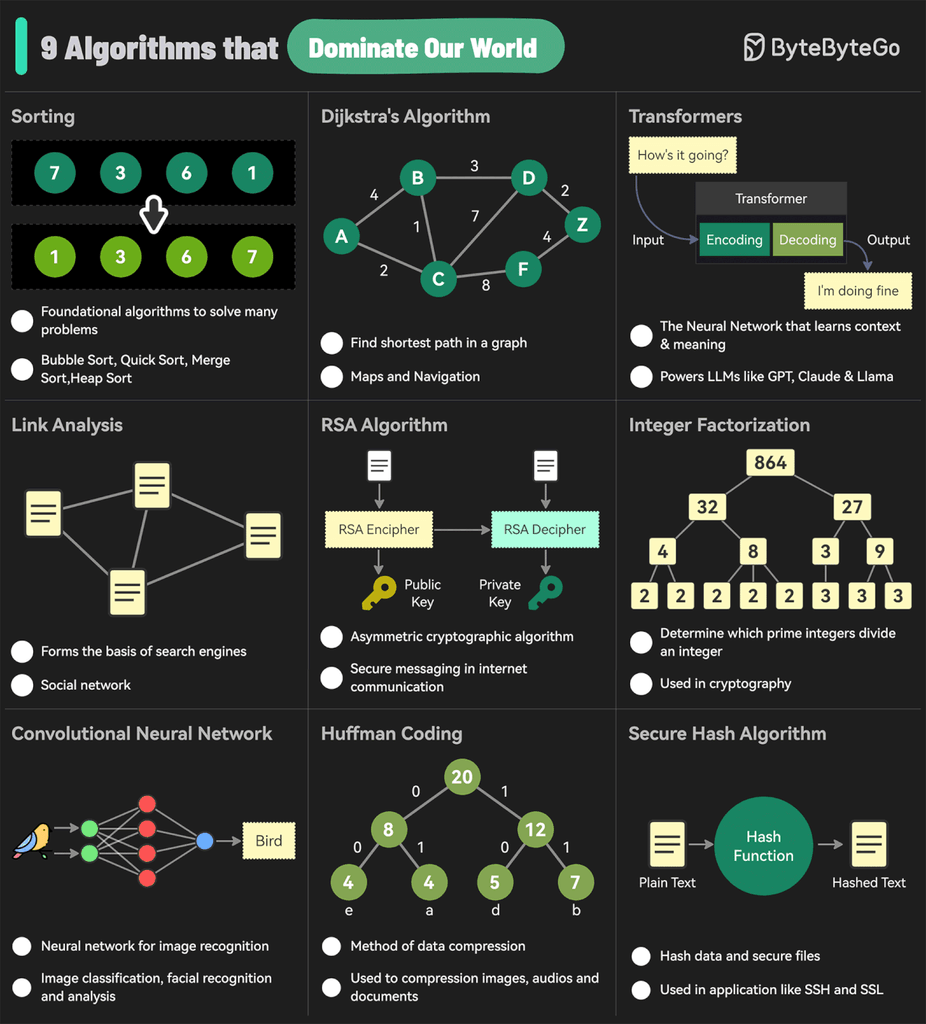
For building AI-powered web and mobile applications, I would prioritize 5 of the 9 algorithms in your infographic. The other four are useful, but less important for most AI SaaS products.
Given your experience with PHP, MySQL, React Native, Expo, and AI-powered applications, here’s how I would rank them.
My ranking for AI app development
| Rank | Algorithm | Importance | Best applications |
|---|---|---|---|
| 1 | Transformers | Very high | AI assistants, text analysis, recommendations, content generation |
| 2 | Link Analysis | Very high | Job aggregators, social networks, recommendation engines |
| 3 | Sorting Algorithms | High | Search results, ranking, personalized feeds |
| 4 | Secure Hash Algorithms | High | Data integrity, deduplication, authentication |
| 5 | Convolutional Neural Networks | High for image apps | Image recognition, OCR pipelines, product identification |
| 6 | Dijkstra’s Algorithm | Medium | Navigation, graph-based recommendations |
| 7 | Huffman Coding | Medium | Storage and data compression |
| 8 | RSA Algorithm | Medium | Secure communication, digital signatures |
| 9 | Integer Factorization | Low | Specialized cryptography and mathematical software |
The five I would focus on
Understanding the Family of Transformer Models. Part I – Language Models | DLog
1. Transformers — The foundation of modern AI apps
Use pretrained models through APIs rather than training your own. They can analyze resumes, generate cover letters, summarize conversations, and extract structured information.
Example: Your CafeJobNet app could compare a candidate’s resume with hundreds of job descriptions and explain the strongest matches.
Visualize open data | Program for Open Scholarship and Education
2. Link Analysis — Discover relationships
Identify connections between jobs, employers, skills, candidates, and industries. Algorithms such as PageRank can help measure importance within networks.
Example: CafeJobNet could discover related employers and career paths based on shared skills.
3. Sorting — Rank the most relevant results
Sorting works with scores generated by AI or conventional ranking systems.
Example: Sort job opportunities by compatibility, salary, location, and freshness. In practice, MySQL can handle most of the sorting.
Unlocking Digital Trust: The Magic Behind JWT Signatures | by Vraj Suratwala | Medium
4. Secure Hash Algorithms — Detect duplicates and protect data integrity
SHA-256 can identify unchanged content and verify files.
Example: When CafeJobNet scrapes employer websites, hashes can detect whether a job description changed and avoid unnecessary AI processing. Passwords should instead use dedicated password-hashing algorithms such as Argon2id.
AcaDraw – Outil IA pour dessins scientifiques | Illustrations en quelques secondes
5. CNNs — Understand images
CNNs are useful for visual recognition, although modern vision transformers and multimodal models are also important.
Example: Your food-photo tracking app could identify foods from pictures and estimate nutritional information, with appropriate uncertainty.
How these algorithms work together in an AI application
Consider an improved version of CafeJobNet:
Company career websitesCollect job descriptions and metadata
SHA-256Detect duplicates and changes
TransformersExtract skills and understand job requirements
Job matching engineCombine semantic similarity, candidate preferences, and eligibility
Link AnalysisDiscover related jobs and skills
SortingRank matches by relevance
Personalized job recommendationsWeb dashboard or Expo mobile application
What should you actually learn first?
There is one important distinction: learning algorithms is different from implementing AI products.
You don’t need to program a transformer neural network from scratch to build a successful AI application. Instead, I recommend learning these technologies in this order:
- LLM APIs and structured outputs — Integrate existing models with PHP or JavaScript.
- Embeddings and vector search — Find semantically similar jobs, documents, products, and conversations.
- Ranking and recommendation systems — Combine AI similarity scores with business rules.
- Graph algorithms — Discover relationships between users, content, and entities.
- Computer vision APIs — Build image-based features without training custom CNNs.
Embeddings and vector search aren’t explicitly included in the infographic, but they’re particularly valuable for the kinds of AI applications you’re developing.
My recommendation for your projects
| Project | Most valuable technology | Potential AI feature |
|---|---|---|
| CafeJobNet | Transformers + vector search | Resume-to-job matching |
| Painpoint SaaS | Transformers + link analysis | Discover recurring customer frustrations |
| Chat-with-texts app | Transformers + embeddings | Search conversations by meaning |
| Food photo tracker | Computer vision + transformers | Recognize food and estimate macros |
| Breakup support app | Transformers | Conversation reflection and journaling |
| Amazon product swiper | Ranking + embeddings | Personalized product recommendations |
The biggest opportunity is combining transformers, embeddings, and ranking algorithms. That combination can power many different SaaS products using the same reusable backend.
For example, you could develop one PHP/MySQL AI matching service and adapt it for matching job candidates to jobs, customers to products, or users to relevant content—without rebuilding the entire AI infrastructure for every app.